GRAMEEN SHIKKHA SAMITY

https://grameenshikkhasamity.com

Banner

“Boss is always right”-a killer advise for any business manager althrough?

There is a general saying that “Boss is always right”. What is its context to the business planning and corporate decision making? How to face the challenges when one needs to improve one’s relationship with a boss; one requires contesting the boss about the improper influences from the boss; when it becomes a necessity to provide advice and coaching to boss; and when it is required to react against any harmful and defective proposal and policy offered by boss? When you are fully conversant with your roles and responsibilities, maintains credibility and trust, remains faithful to your values and convictions and after all you work for the interest of the business or the organization, should it not be easy and logical to enter into challenging interactions with your boss. What do you think?

Experiences and expert opinions suggest the following 8 tips in terms of interacting with the boss for the interest of any business organization:

Take the initiative about solving any problem

This means taking any problem to the boss and suggesting ways to deal with the specific problem. Taking initiatives often involves risks but if done appropriately and carefully it can add value to your credibility to the boss.

Update the boss about your decisions

The boss should be kept informed about the actions and decisions regarding the solutions of the problems following the initiatives so taken as a result of earlier discussions with the boss. This is just to keep the boss updated about the situation.

Provide Verified and accurate information to the boss

It is a key responsibility to provide correct and timely information to the boss to make right decisions, as necessary. It is also very important as well as a necessity to verify accuracy of the information in order to remain trusted and dependable to the boss.

Seek honest feedback from the boss

It is always desirable to encourage the boss to give honest feedback about your performance including strengths and weaknesses and rooms for improvement. This is necessary to improve mutual trust and cooperation.

Facilitate and Support when boss is working as a change agent

Express supports and encouragements to the boss to overcome any resistance to any necessary and desirable change in the organization. Offer to assist the boss to handle any urgent work during any crisis situation.

Praise and appreciate the boss in right time

It is appropriate to express sincere appreciation when the boss represents your interest highly and satisfactorily in the organization or carry out a difficult task in the organization with special effort and strategy successfully.

Contest the boss against harmful and defective proposals

You can make a valuable contribution to the organization by providing accurate and sincere feedback politely about the boss’s plans and proposals which are harmful and defective. It may also be necessary to use influence and persuasion through peer pressure and coalitions in order to convince the boss accordingly.

Plan for upward coaching and counseling as necessary

Coaching is usually viewed as a privilege of the boss. But you also have the opportunity to coach especially the new and inexperienced boss in terms of upward coaching and upward counseling.. This also becomes easier when you have a deep, cordial as well as trusted relationship with the boss. Experiences indicate that upward counseling is necessary and it is also appreciated by the boss in most cases.

General

Justifiably, the above discussions and analysis should provide you with significant insight into the proposition associated with the “Boss is always right” vis-à-vis the business planning and corporate decision making process. We believe that both the boss and the boss’s associates will find this article useful and beneficial.

What are Sustainable Development Goals that can open opportunities for world peace and harmony?

“The Sustainable Development Goals (SDGs), also known as the Global Goals, were adopted by the United Nations in 2015 as a universal call to action to end poverty, protect the planet, and ensure that by 2030 all people enjoy peace and prosperity” (UNDP).

Sustainable Development Goals (SDGs) are gold drops to accelerate the development gears of the countries and to promote world peace and harmony. UN and its Partner countries adopted the current sustainable development goals for promoting and stabilizing poverty alleviation; environmental protection; human development; and national welfare and prosperity.

SDGs refers to 17 sustainable goals associated with achievable targets and verifiable indicators. SDGs are able to contribute to  transform the world if implemented effectively as per set policies and guidelines.

“The 17 SDGs are integrated—they recognize that action in one area will affect outcomes in others, and that development must balance social, economic and environmental sustainability” (UNDP).

This is a fact that UN Partners have diversified political and development perspectives and interests. Nevertheless, the SDGs are able to bring them together in a common platform which can promote world peace and harmony tremendously. This needs full understanding and commitment  by the UN Partner countries to implement the Sustainable Development Goals for mutual benefit of  the respective partner countries and our loving world.

The following slideshow presents the 17 SDGs adopted by the UN and the Partners:

Image source:UNDP

Sustainable Development Goals

Image Source:UNDP

How Decent work improve efficiency and productivity leading to poverty alleviation?

Background

ILO has initiated the concept of Decent Work. Decent Work  has been integrated as a component of SDGs (Sustainable Development Goals) and promoted by the Partners of the UN countries.

What is Decent Work?

The core value of Decent Work  involves  a work situation that  is productive and at the same time delivers a fair income for the workers involved. This again prompts us to argue that Decent Work does not only mean  an access to work but it also points to the qualitative mix  of works that affects the  workers at large.

Why Decent Work?

Experiences  indicate that workers care for the Decent Work and the  Decent Work improves work efficiency and productivity significantly that adds value to progress and development of any country overtime

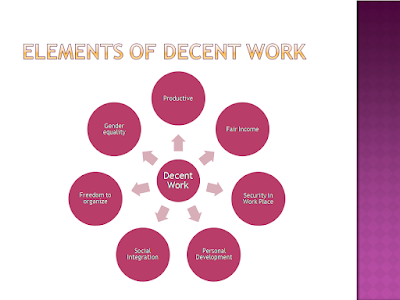
Elements of Decent Work

Decent work contains different elements that induce different functional capabilities of decent work. Elements  of  Decent Work  are presented in below diagram:

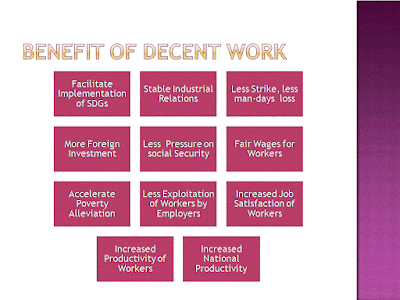
Benefit of Decent Work

Multiple benefits result from the implementation of decent work strategies. The below figure shows typical  benefit of Decent Work:

Challenges of Decent Work

Implementation of Decent Work strategies cannot go without any challenge. A few        such major challenges of decent work include the following:

  • Clear Policies and laws relating to decent work to be defined and formulated by the UN Partner countries.
  • A useful and precise information base to be established and monitored on regular basis.
  • Adoption of positive attitude and work ethics by the workers.
  • Vulnerable groups of workers (disabled, migrant workers, etc.)  should have access to decent work.
  • Extent of willingness of the Government, the workers and the employers to effectively participate  in the process of implementing  decent work.

General

One estimate indicates that  effective implementation of Decent Work and economic growth strategies can enable over 800 million more workers in developing countries to earn the fair wage they need to lift themselves out of poverty.

Justifiably the UN Partner countries need to implement the Decent Work principles and strategies with much dedication and commitment in order to be able to facilitate and accelerate the intended progress and development of respective countries overtime.

Create an Amazon Wedding Registry Create an Amazon Wedding Registry Create an Amazon Wedding Registry>